Payroll Software in Delhi for Businesses | ZFour HRMS (2026)
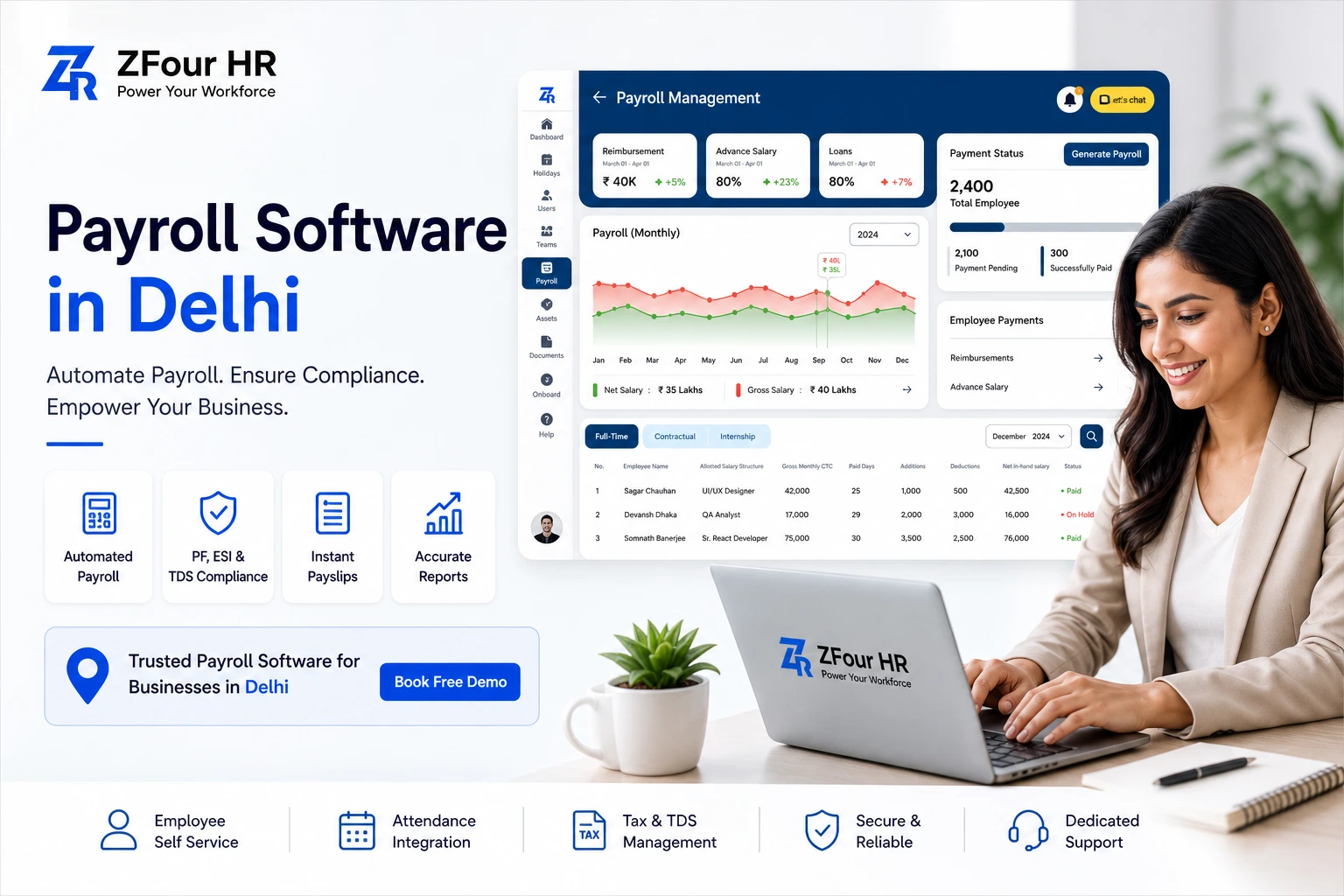
Managing payroll has become one of the most important responsibilities for businesses in Delhi. Whether you're a startup in Connaught Place, an IT company in Nehru Place, a manufacturing unit in Okhla, or a growing enterprise in Gurgaon or Noida, accurate payroll processing is essential for maintaining employee trust, ensuring statutory compliance, and supporting business growth.
Payroll is no longer limited to calculating monthly salaries. Modern organizations must also manage attendance, overtime, bonuses, reimbursements, tax deductions, Provident Fund (PF), Employee State Insurance (ESI), professional tax (where applicable), and detailed payroll reporting. Handling these processes manually through spreadsheets increases the risk of calculation errors, compliance issues, delayed salary payments, and administrative overhead.
Cloud-based payroll software has transformed the way organizations manage payroll by automating repetitive tasks and centralizing workforce information. Instead of relying on multiple disconnected systems, businesses can manage salary processing, attendance, leave, compliance, employee records, and payroll reports from a single secure platform.
ZFour HRMS is a cloud-based payroll and HR management solution designed specifically for Indian businesses. It enables startups, SMEs, and enterprises to automate payroll, reduce manual work, maintain compliance with statutory regulations, and improve overall workforce efficiency.
Whether your business employs 20 people or 2,000, implementing payroll automation helps reduce operational complexity while creating a better experience for both HR teams and employees.
Quick Answer
Payroll software is a cloud-based solution that automates salary processing, attendance integration, tax deductions, payslip generation, and statutory compliance. Businesses in Delhi use payroll software like ZFour HRMS to reduce manual errors, improve payroll accuracy, save time, and simplify compliance with Indian payroll regulations.
Key Takeaways
Payroll automation reduces manual calculations and administrative workload.
Cloud payroll software improves payroll accuracy and statutory compliance.
Businesses can automate PF, ESI, TDS, attendance, and salary processing through one platform.
Employee self-service improves transparency and reduces HR dependency.
ZFour HRMS provides an integrated payroll and workforce management solution for businesses across Delhi NCR.
Why Payroll Management Matters More Than Ever
Payroll directly affects employee satisfaction, financial planning, compliance, and organizational credibility. Even a single payroll mistake can lead to employee disputes, delayed salaries, incorrect tax deductions, or regulatory penalties.
As businesses grow, payroll becomes increasingly complex due to factors such as:
Multiple salary structures
Variable pay components
Attendance-based calculations
Overtime management
Leave deductions
Bonus calculations
Statutory deductions
Compliance reporting
Without automation, managing these activities manually requires significant time and increases the likelihood of human error.
Today's businesses need payroll systems that are not only accurate but also scalable enough to support long-term growth.
What Is Payroll Software?
Payroll software is a digital platform that automates the complete payroll process, from salary calculations to statutory compliance and employee payslip generation.
Instead of relying on spreadsheets or manual calculations, organizations use payroll software to process salaries accurately, maintain compliance, and generate reports with minimal manual effort.
A modern payroll management system typically includes:
Employee database
Salary structure management
Attendance integration
Leave management
Overtime calculation
Bonus and incentive processing
PF and ESI management
TDS calculations
Payslip generation
Payroll reports
Employee self-service
Cloud payroll software also enables HR teams to access payroll information securely from any location, making it suitable for office, hybrid, and remote work environments.
Why Businesses in Delhi Need Payroll Software
Delhi has one of India's most dynamic business ecosystems, with startups, IT companies, BPOs, retailers, manufacturers, healthcare providers, educational institutions, and multinational corporations operating across the region. As these organizations grow, managing payroll manually becomes increasingly challenging.
Payroll software helps businesses overcome common operational issues by automating repetitive processes, reducing errors, and ensuring compliance with statutory regulations.
Key Reasons Businesses Choose Payroll Software
1. Simplified Statutory Compliance
Payroll software automatically calculates statutory deductions such as Provident Fund (PF), Employee State Insurance (ESI), and Tax Deducted at Source (TDS), helping businesses remain compliant with Indian regulations.
For official compliance updates, businesses should refer to the Employees' Provident Fund Organization (EPFO), Employees' State Insurance Corporation (ESIC), and the Ministry of Labour & Employment.
2. Faster Payroll Processing
Manual payroll often requires hours or even days of effort every month. Payroll automation significantly reduces processing time by calculating salaries, deductions, reimbursements, and bonuses automatically.
3. Improved Payroll Accuracy
Automation minimizes calculation errors and ensures employees receive accurate salaries on time.
4. Better Employee Experience
Employees can securely access payslips, salary details, attendance records, and tax documents through an employee self-service portal, reducing dependency on HR teams.
5. Business Scalability
As businesses expand across Delhi NCR, payroll software can support larger workforces, multiple branches, and more complex payroll structures without increasing administrative burden.
Manual Payroll vs. Cloud Payroll Software
Feature | Manual Payroll | Cloud Payroll Software |
|---|---|---|
Salary Calculations | Manual | Automated |
Payroll Accuracy | Error-prone | High Accuracy |
PF & ESI Compliance | Manual | Automated |
Attendance Integration | Separate Process | Integrated |
Payslip Generation | Manual | Instant |
Payroll Reports | Time-Consuming | Real-Time |
Employee Access | HR Dependent | Self-Service Portal |
Scalability | Limited | Highly Scalable |
Data Security | Spreadsheet-Based | Secure Cloud Storage |
Workforce Analytics | Limited | Advanced Dashboards |
Businesses transitioning from manual payroll to cloud-based systems often experience faster payroll cycles, improved compliance, and better operational efficiency.
Why Modern Businesses Prefer Cloud Payroll Software
Traditional payroll systems require extensive manual intervention and often depend on local files or spreadsheets. Cloud payroll software provides secure, centralized access to payroll information from any location.
Key advantages include:
Remote accessibility
Automatic software updates
Secure cloud infrastructure
Role-based access control
Reduced IT maintenance
Seamless integration with attendance and HR systems
For growing businesses, cloud payroll software provides the flexibility needed to support hybrid work models, multi-location operations, and workforce expansion.
Benefits of Using Payroll Software for Businesses in Delhi
Payroll is much more than processing monthly salaries. It directly impacts employee satisfaction, statutory compliance, financial planning, and overall business efficiency. As organizations expand, payroll complexity increases with multiple salary structures, shift schedules, overtime calculations, reimbursements, bonuses, and tax obligations. Modern payroll software helps businesses automate these processes while reducing manual intervention and improving operational accuracy.
1. Faster Payroll Processing
Processing payroll manually often requires HR and finance teams to spend several days collecting attendance records, verifying leave balances, calculating deductions, and preparing salary statements. Payroll software automates these repetitive tasks, enabling organizations to complete payroll processing in a fraction of the time.
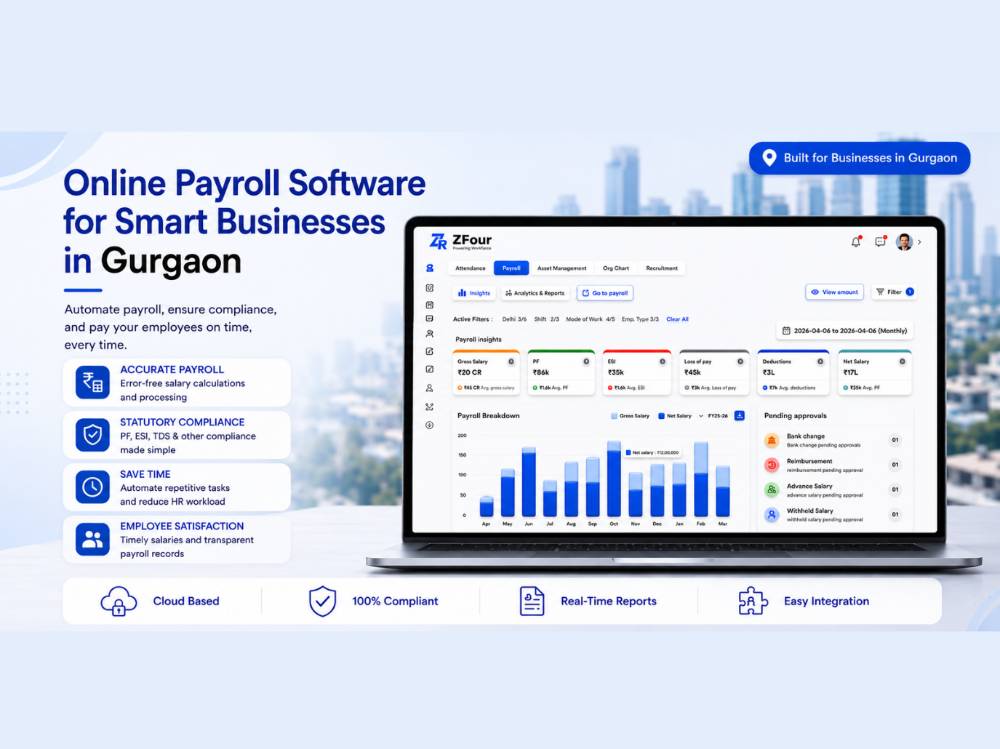
With ZFour HRMS, payroll calculations are generated automatically based on predefined salary structures, attendance records, overtime, incentives, and statutory deductions. This allows HR teams to focus on strategic workforce initiatives instead of repetitive administrative work.
Business Benefits
Reduced payroll processing time
Automated salary calculations
Faster payroll approvals
Timely salary disbursement
Improved operational productivity
2. Improved Payroll Accuracy
Manual calculations increase the likelihood of payroll errors, especially when organizations manage a growing workforce. Incorrect salary payments, inaccurate overtime calculations, or tax deduction mistakes can lead to employee dissatisfaction and additional administrative effort.
Payroll software minimizes these risks by applying predefined rules consistently across every payroll cycle.
The system automatically calculates:
Basic salary
House Rent Allowance (HRA)
Overtime
Bonuses
Incentives
Leave deductions
Provident Fund (PF)
Employee State Insurance (ESI)
Tax Deducted at Source (TDS)
Net salary
This significantly improves payroll accuracy while reducing disputes and manual corrections.
3. Automated Statutory Compliance
Compliance is one of the most critical responsibilities for HR and payroll teams. Businesses must adhere to regulations related to PF, ESI, TDS, employee records, and other statutory obligations. Tracking these requirements manually becomes increasingly difficult as organizations grow.
Payroll software simplifies compliance by automatically calculating statutory deductions, maintaining digital payroll records, and generating compliance reports.
For the latest regulations, businesses should refer to:
Employees' Provident Fund Organization (EPFO)
Employees' State Insurance Corporation (ESIC)
Ministry of Labour & Employment
Income Tax Department
Automating compliance reduces the risk of penalties while ensuring payroll processes remain aligned with applicable regulations.
4. Enhanced Employee Experience
Today's employees expect transparency, speed, and self-service capabilities. Modern payroll software allows employees to access essential payroll information without depending on HR for routine requests.
Employees can:
Download payslips
View salary history
Access tax documents
Check attendance records
Review leave balances
Update personal information
This improves employee satisfaction while reducing administrative workload for HR teams.
5. Better Workforce Visibility Through Payroll Analytics
Payroll software is no longer limited to salary processing. It also provides valuable workforce insights that help business leaders make informed decisions.
HR and finance teams can monitor:
Payroll expenses
Attendance trends
Overtime costs
Department-wise salary expenditure
Employee compensation trends
Payroll compliance status
These reports support budgeting, workforce planning, and long-term business strategy.
Key Features of ZFour Payroll Software
ZFour HRMS combines payroll management with comprehensive HR automation to provide businesses with a single platform for managing their workforce.
Automated Salary Processing
The payroll engine automatically calculates salaries based on attendance, shift timings, overtime, incentives, reimbursements, and predefined salary structures.
Benefits
Reduced manual calculations
Faster payroll cycles
Improved payroll consistency
Fewer payroll disputes
Attendance Integration
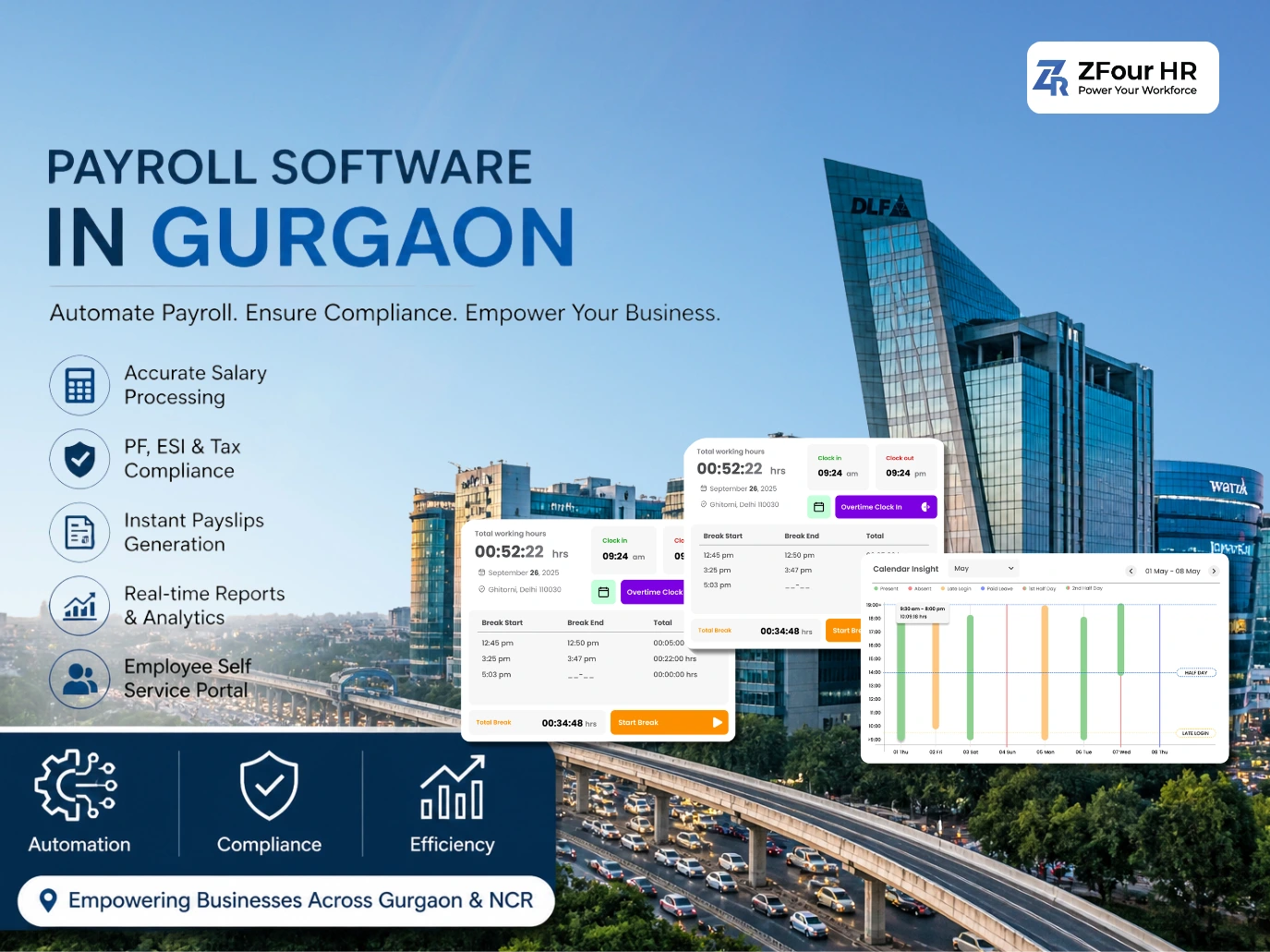
Accurate payroll depends on accurate attendance. ZFour HRMS integrates payroll with attendance management, ensuring salary calculations are based on verified employee attendance data.
Attendance Features
Attendance Feature | Business Benefit |
|---|---|
Attendance Synchronization | Accurate salary calculations |
Shift Management | Better workforce scheduling |
Overtime Tracking | Correct payroll processing |
Biometric Integration | Reduced attendance fraud |
Remote Attendance | Supports hybrid and remote teams |
This integration eliminates duplicate data entry and reduces payroll errors.
Leave Management Integration
Leave balances directly affect payroll. Manual leave tracking often leads to discrepancies between attendance records and salary calculations.
ZFour HRMS automates:
Leave requests
Manager approvals
Leave balance updates
Payroll deductions
Holiday calendars
This creates a seamless workflow between HR and payroll operations.
Explore ZFour's Leave Management System to simplify leave approvals and improve workforce transparency.
Employee Self-Service Portal
Employee self-service (ESS) improves workforce efficiency by allowing employees to manage routine HR activities independently.
Employees can:
Access payslips
Download tax forms
Apply for leave
Check attendance
Update personal information
View payroll history
By reducing dependency on HR teams, organizations improve both employee experience and HR productivity.
Learn more about ZFour's Employee Management System for centralized workforce administration.
Payroll Reports and Business Analytics
ZFour HRMS provides comprehensive reporting capabilities that enable organizations to analyze payroll performance and workforce expenses in real time.
Key reports include:
Payroll summaries
Salary registers
Department-wise payroll reports
Attendance reports
Overtime reports
Tax reports
Compliance reports
These insights support better financial planning and workforce optimization.
How Payroll Software Works
Understanding the payroll workflow helps organizations appreciate how automation simplifies payroll management.
Step 1: Employee Information
HR teams configure employee profiles, salary structures, tax information, bank details, and statutory information within the payroll system.
Step 2: Attendance Synchronization
Attendance, leave records, shift schedules, and overtime data are automatically synchronized from the attendance management module.
Step 3: Salary Calculation
The payroll engine calculates gross salary, allowances, deductions, bonuses, incentives, reimbursements, and statutory contributions according to predefined rules.
Step 4: Compliance Verification
The system automatically applies statutory deductions such as PF, ESI, and TDS while generating payroll records that support compliance requirements.
Step 5: Payslip Generation
Digital payslips are generated automatically and made available to employees through the Employee Self-Service Portal.
Step 6: Payroll Reporting
Comprehensive reports provide HR teams and business leaders with actionable insights into payroll expenses, workforce costs, and compliance status.
Why Cloud-Based Payroll Software Is Better Than Traditional Systems
Businesses are increasingly replacing desktop payroll software and spreadsheets with cloud-based platforms because they offer greater flexibility, security, and scalability.
Advantages of Cloud Payroll Software
Access payroll securely from anywhere
Automatic software updates
Secure cloud storage
Lower infrastructure costs
Real-time collaboration
Scalable workforce management
Easy integration with HR modules
Reduced IT maintenance
For businesses operating across Delhi NCR with multiple branches or remote employees, cloud payroll software provides the flexibility needed to support modern workforce management.
Payroll Compliance in India: Why It Matters for Every Business
Payroll compliance is one of the most critical aspects of workforce management. Beyond paying employees accurately and on time, businesses must comply with statutory regulations governing employee benefits, tax deductions, and payroll reporting. Failure to comply can lead to financial penalties, legal complications, employee disputes, and reputational damage.
For businesses in Delhi and across India, payroll compliance involves managing multiple statutory obligations while keeping up with regulatory updates. As organizations grow, manual compliance management becomes increasingly difficult. Cloud-based payroll software simplifies this process by automating statutory calculations, maintaining accurate records, and generating compliance-ready reports.
Key Payroll Compliance Requirements in India
Modern payroll software should support the following statutory requirements:
Provident Fund (PF)
The Employees' Provident Fund (EPF) is a mandatory retirement savings scheme that requires eligible employers and employees to contribute a prescribed percentage of wages. Payroll software automates PF calculations, maintains contribution records, and reduces manual errors.
For official guidelines and updates, businesses should refer to the Employees' Provident Fund Organization (EPFO).
Employee State Insurance (ESI)
The Employees' State Insurance (ESI) scheme provides medical and financial benefits to eligible employees. Payroll software automatically calculates ESI contributions based on applicable salary thresholds, ensuring compliance with statutory requirements.
Businesses can verify eligibility and contribution rules through the Employees' State Insurance Corporation (ESIC).
Tax Deducted at Source (TDS)
Payroll systems also calculate Tax Deducted at Source (TDS) based on applicable income tax regulations, helping organizations reduce calculation errors and maintain accurate tax records.
Businesses should consult the Income Tax Department for the latest tax rules and compliance updates.
Labor Regulations
Organizations must also comply with employment laws covering wages, employee records, leave policies, and workplace regulations. Businesses should monitor updates published by the Ministry of Labour & Employment to ensure compliance with applicable labor legislation.
Why Payroll Compliance Is Challenging
Many growing businesses continue to rely on spreadsheets or manual payroll systems despite increasing workforce complexity.
Common compliance challenges include:
Frequent statutory updates
Manual calculation errors
Incorrect employee classifications
Delayed payroll approvals
Missing compliance reports
Inconsistent attendance records
Poor document management
Limited audit readiness
As employee numbers increase, these challenges become more difficult to manage, increasing operational risk.
Cloud payroll software eliminates these bottlenecks through automation and centralized workforce management.
Payroll Security: Protecting Sensitive Employee Data
Payroll systems store some of the most confidential information within an organization, including employee salaries, bank account details, tax records, government identification numbers, attendance data, and employment documents.
A secure payroll platform should protect this information through modern security controls while providing authorized users with seamless access.
Essential Payroll Security Features
Cloud Encryption
Encryption protects payroll information both during transmission and while stored in the cloud.
Role-Based Access
Different users should only access information relevant to their responsibilities.
For example:
HR Managers
Payroll Administrators
Finance Teams
Department Managers
Employees
Each role receives appropriate permissions while protecting confidential payroll information.
Multi-Factor Authentication
Modern payroll platforms increasingly support multi-factor authentication to strengthen account security and reduce unauthorized access.
Automated Backups
Cloud payroll systems automatically back up payroll records, reducing the risk of permanent data loss.
Audit Trails
Payroll audit logs record user activities, helping organizations improve transparency and simplify internal audits.
How Artificial Intelligence Is Transforming Payroll
Artificial Intelligence is rapidly changing how businesses manage payroll and workforce operations. Instead of simply automating calculations, AI helps organizations predict trends, identify anomalies, and make smarter workforce decisions.
AI-Powered Payroll Capabilities
Intelligent Payroll Validation
AI can identify unusual salary variations, duplicate payments, or unexpected deductions before payroll is finalized.
Attendance Pattern Analysis
Machine learning algorithms analyze attendance data to identify trends such as excessive absenteeism, overtime dependency, or workforce scheduling inefficiencies.
Predictive Workforce Analytics
AI enables HR leaders to forecast:
Payroll expenses
Workforce growth
Hiring requirements
Overtime costs
Employee turnover
These insights support better budgeting and workforce planning.
Automated Employee Support
AI-powered virtual assistants help employees access payroll information, download payslips, understand salary components, and answer routine HR questions without requiring HR intervention.
Smart Compliance Monitoring
Future payroll platforms will increasingly use AI to monitor regulatory changes and notify organizations about potential compliance risks before they occur.
Return on Investment (ROI) of Payroll Automation
Payroll software is often viewed as an operational tool, but it also delivers measurable business value.
Organizations implementing payroll automation typically experience improvements in efficiency, accuracy, and workforce productivity.
Business Benefits of Payroll Automation
Business Area | Impact of Payroll Automation |
|---|---|
Payroll Processing | Faster salary calculations |
Administrative Work | Reduced manual effort |
Compliance | Improved statutory accuracy |
Employee Experience | Higher satisfaction |
Payroll Accuracy | Fewer calculation errors |
Reporting | Real-time analytics |
Business Growth | Easier workforce scalability |
Rather than spending valuable time on repetitive calculations, HR teams can focus on employee engagement, recruitment, and workforce development.
ZFour HRMS vs Other Payroll Software
Choosing payroll software involves evaluating functionality, scalability, compliance capabilities, and ease of use.
Below is a comparison between ZFour HRMS and traditional payroll approaches.
Feature | ZFour HRMS | Manual Payroll | Basic Payroll Tools |
|---|---|---|---|
Automated Salary Processing | ✔ | ✘ | Partial |
Attendance Integration | ✔ | ✘ | Limited |
Leave Management | ✔ | ✘ | Limited |
Employee Self-Service | ✔ | ✘ | Partial |
Payroll Reports | ✔ | Manual | Basic |
Cloud Accessibility | ✔ | ✘ | Varies |
Compliance Automation | ✔ | Manual | Partial |
Workforce Analytics | ✔ | ✘ | Limited |
Scalability | High | Low | Medium |
Unlike standalone payroll applications, ZFour HRMS integrates payroll with attendance, leave management, employee records, and workforce analytics to provide a unified HR platform.
Real Business Case Study
How Payroll Automation Helped a Growing Delhi Business
A technology startup in Delhi with approximately 150 employees relied on spreadsheets to manage payroll, attendance, and statutory deductions.
Each month, the HR team spent several days:
Collecting attendance records
Verifying overtime
Calculating salaries
Updating spreadsheets
Preparing payslips
Reviewing compliance data
As the organization expanded, payroll processing became increasingly time-consuming. Attendance discrepancies delayed salary approvals, manual calculations increased payroll corrections, and HR teams struggled to maintain statutory documentation.
After implementing ZFour HRMS, the company centralized payroll and workforce management into a single cloud-based platform.
The organization was able to:
Automate salary processing
Integrate attendance with payroll
Generate digital payslips instantly
Improve payroll accuracy
Reduce administrative workload
Simplify statutory compliance
Provide employees with self-service access
The result was a more efficient payroll process, improved employee confidence, and greater visibility into workforce operations.
Internal Resources
To further strengthen your HR ecosystem, explore these related solutions on ZFour:
HRMS Software
Attendance Management System
Leave Management System
Employee Management Software
Performance Management System
Recruitment Management
Employee Self-Service Portal
Workforce Analytics
These integrated solutions help businesses manage the complete employee lifecycle through a centralized cloud platform.
The Future of Payroll Software: Trends Shaping Workforce Management in 2026 and Beyond
Payroll technology is rapidly evolving beyond salary processing. Organizations are increasingly adopting cloud-based HR platforms, artificial intelligence, predictive analytics, and automation to simplify workforce management while improving employee experience.
Future-ready payroll systems will combine HR, payroll, attendance, compliance, performance management, and workforce analytics into one intelligent ecosystem.
Emerging Payroll Trends
AI-Powered Payroll Automation
Artificial Intelligence helps automate payroll validation, identify anomalies, predict workforce costs, and reduce manual intervention.
Predictive Workforce Analytics
Organizations can forecast payroll expenses, hiring requirements, overtime costs, and workforce trends using data-driven insights.
Intelligent Compliance Monitoring
Modern payroll systems are expected to automatically adapt to statutory updates, reducing compliance risks and administrative effort.
Employee Self-Service & Mobile Accessibility
Employees increasingly expect instant access to payslips, tax documents, leave balances, attendance records, and reimbursement status through mobile-friendly self-service portals.
Cloud-Based Workforce Management
Cloud HR platforms enable businesses to securely manage payroll and workforce operations across multiple branches, remote teams, and hybrid workplaces.
Businesses adopting these technologies today will be better prepared for tomorrow's workforce challenges.
Why Businesses Choose ZFour HRMS
Selecting the right payroll software is about more than automation—it's about choosing a platform that supports long-term business growth.
ZFour HRMS combines payroll, attendance, leave management, recruitment, employee self-service, compliance, and analytics into one integrated cloud-based solution.
Why ZFour Stands Out
Cloud-based payroll and HRMS platform
Automated payroll processing
PF, ESI, and TDS compliance support
Attendance and biometric integration
Leave management automation
Employee Self-Service Portal
Real-time payroll reports and analytics
Secure cloud infrastructure
Scalable for startups, SMEs, and enterprises
User-friendly interface with dedicated support
Whether you're managing a startup with 20 employees or a growing enterprise with thousands of employees, ZFour HRMS provides the flexibility and automation needed to streamline payroll operations.
Final Thoughts
Managing payroll is no longer just about processing salaries—it has become a strategic business function that directly impacts employee satisfaction, operational efficiency, and regulatory compliance. As organizations grow, manual payroll processes become increasingly difficult to manage, often leading to calculation errors, administrative delays, and compliance challenges.
A modern cloud-based payroll platform enables businesses to automate salary processing, attendance management, statutory deductions, leave tracking, and payroll reporting while improving workforce transparency and reducing manual effort.
For businesses in Delhi and across India, investing in payroll automation today creates a strong foundation for future growth. Organizations that adopt intelligent payroll solutions are better positioned to improve operational efficiency, support workforce expansion, and deliver a seamless employee experience.
By combining payroll automation with attendance management, employee self-service, compliance support, and workforce analytics, ZFour HRMS helps businesses simplify HR operations and build a future-ready workforce.
Ready to Transform Your Payroll Process?
Manual payroll should never slow your business growth. Whether you're a startup, SME, or enterprise, ZFour HRMS helps you automate payroll, attendance, leave management, compliance, employee self-service, and workforce analytics from one secure cloud-based platform.
Why Choose ZFour HRMS?
✔ Automated Payroll Processing
✔ PF, ESI & TDS Compliance
✔ Attendance & Leave Integration
✔ Employee Self-Service Portal
✔ Payroll Reports & Analytics
✔ Secure Cloud Infrastructure
✔ Built for Indian Businesses
✔ Scalable for Growing Teams
Book a Free Demo Today and discover how ZFour HRMS can simplify payroll management, improve compliance, and support your organization's long-term growth.